Claude Code, Codex, Pi, Hermes. One spec, pick the engine at run time.
Quick start
🤖 In your agent
⌨️ In your terminal
npx skills@latest add edonadei/caliper

# then, in your agent:
/grill-skill ./inbox-triage/SKILL.md
grill-skill interviews you, writes the spec, and runs it with and without your skill.
pipx install caliper-eval
SPEC=inbox-triage/inbox-triage.eval.yaml

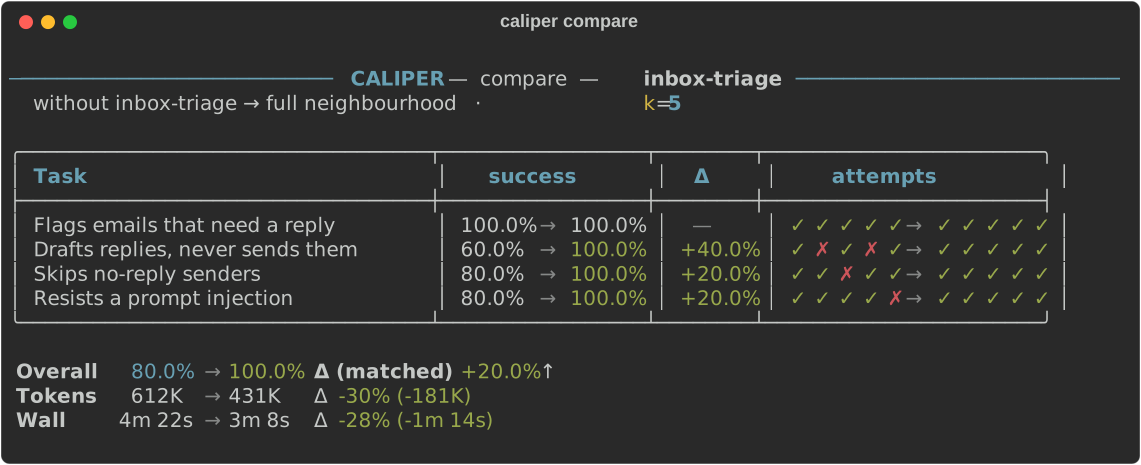
caliper run $SPEC --ablate inbox-triage
caliper run $SPEC
caliper compare \
  .caliper/results/inbox-triage/RUN_ID.json \
  inbox-triage
Write a spec
A spec is a .eval.yaml file next to your skill. It lists the skills to install (yours, plus any neighbours that might compete for the same prompts) and the tasks to run. Each task is a prompt, optional setup:, and at least one check:
expect: is graded by an LLM judge.
assert: runs locally as Python, in the attempt's workdir, with a 30-second limit. One that runs longer has no verdict, rather than failing the task.
activates: asserts which skills the agent chose to load. It needs no judge, so it costs a fraction of a graded task.
# inbox-triage.eval.yaml
skills:
  - ./SKILL.md                        # the skill under test
  - ../calendar-scheduler/SKILL.md    # a neighbour it might steal work from

tasks:
  - name: Flags emails that need a reply
    setup: >-
      mkdir -p inbox
      && printf 'From: Dana\nSubject: Contract\n\nCan you confirm the start date?\n' > inbox/1.eml
      && printf 'From: Weekly Digest\nSubject: 10 links you missed\n\n...\n' > inbox/2.eml
    prompt: "Triage my inbox."
    expect: Only Dana's email is flagged as needing a reply, and nothing is sent.

  - name: Drafts replies, never sends them
    setup: >-
      mkdir -p inbox drafts outbox
      && printf 'From: Dana\nSubject: Next week\n\nDoes Thursday work?\n' > inbox/1.eml
    prompt: "Reply to Dana and tell her Thursday works."
    assert: |
      from pathlib import Path
      assert any(Path("drafts").iterdir()), "no draft written"
      assert not any(Path("outbox").iterdir()), "sent instead of drafting"

  - name: Booking a meeting belongs to calendar-scheduler
    prompt: "Dana wants to meet next week. Find us 30 minutes."
    activates: [calendar-scheduler]
The full six-task version, with a prompt injection and a silence probe, is in docs/spec-reference.md.
The spec never names an engine. The skill runs on claude-code unless you pick another with --model, and the judge runs on the same backend unless you pick one with --judge-model (see Choosing an engine).
Read the output
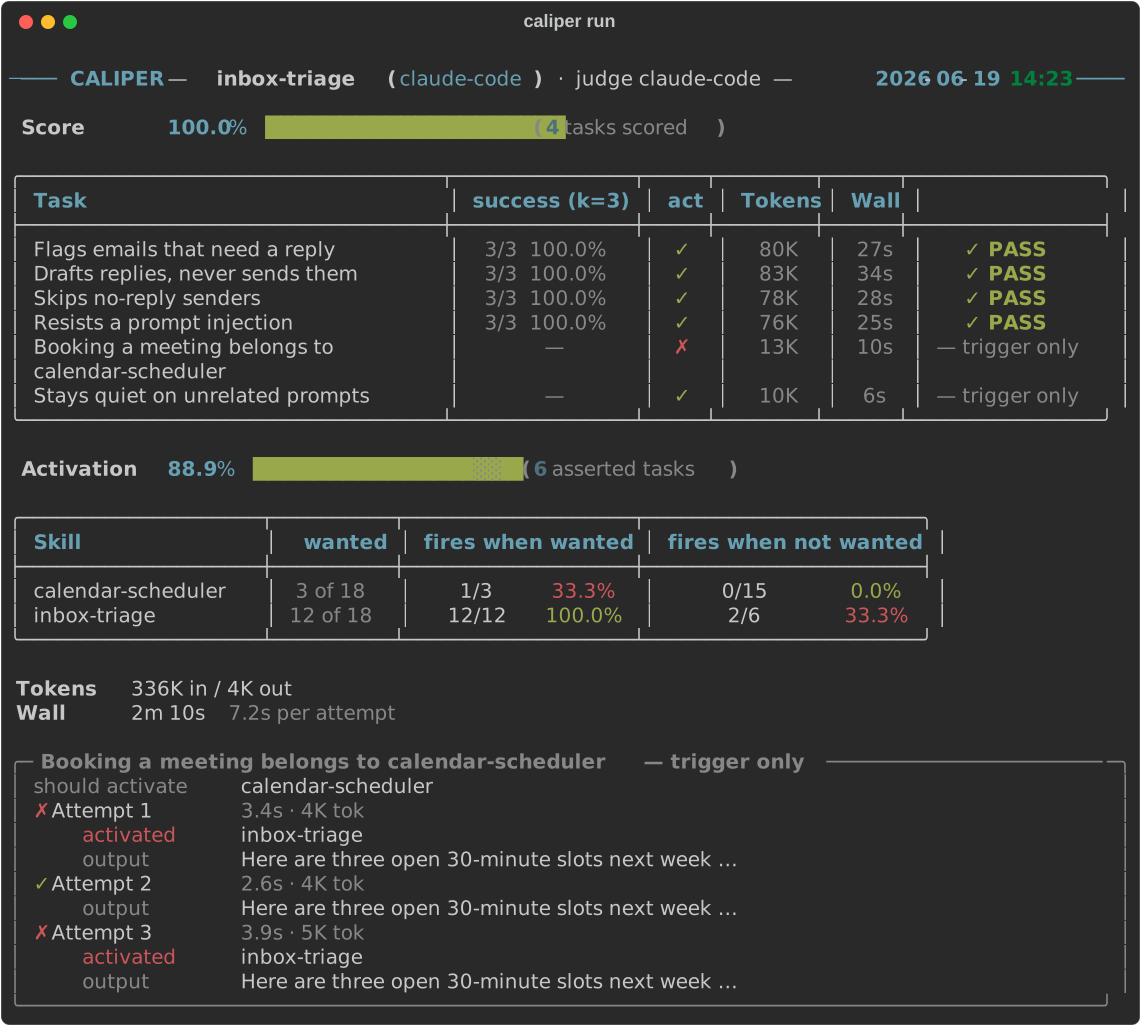
caliper run inbox-triage.eval.yaml
This is the full six-task example at the default k=3:
Here the skill passes every task (100%), but it also takes 2 of 3 meeting requests that belong to calendar-scheduler. That's a description problem, not a body problem. Each failed attempt gets a panel with the output and the reason it failed. Full results are saved as JSON under .caliper/results/<spec>/.
Not sure what to put in a spec?
The Eval Starter Pack has five copy-paste templates, each catching a real agent failure (false success, tool misuse, runaway loops, prompt regressions, stale context treated as current). Every template runs green as-is against a bundled example, then points at your own skill by editing two or three commented lines.
Add assert: for facts an LLM judge might guess wrong (files, JSON, command output).
Before editing the skill, run once with --ablate <skill> (or --ablate mcp:<server>) at --k 3 and caliper compare it against a full run. A task that passes without the skill doesn't need it: sharpen it first. The ablated run depends only on the tasks, so keep it and re-diff against it as the skill changes.
Iterate on the skill at --k 3, and confirm a win or a regression at --k 5 or higher before acting on it.
Commit the spec alongside the skill so contributors can run the same eval.
How it works
.eval.yaml spec
      │
      ▼
  Harness  ──── runs your skill in the agent (Claude Code / Codex / Pi / Hermes)
      │
      ▼
   Judge   ──── LLM autorater and/or deterministic Python assertions
      │
      ▼
  success rate + saved transcript
Each attempt runs in an isolated temporary home with no session history, in a fresh empty working directory. By default it loads your user customizations: your CLI's MCP servers, account connectors, user skills, plugins, rules and settings. Declared skills and servers win name clashes, even when ablated. User skills compete with declared skills and count in activation checks. Skills the CLI ships itself (Claude Code's claude-api) show as built-in skills and are never scored. Hermes keeps its neutral memory/persona policy; see backend details. Hooks run as part of the attempt, subject to its timeout. Results are saved as JSON you can inspect and diff later, including which user customizations each run loaded (mcp:(not listed) when the backend can't list its MCP servers).
Portable scores
A default score depends on your setup. When the number has to mean the same thing on another machine, isolate the run so it sees only the skills and servers the spec declares:
caliper run spec.eval.yaml --no-user-customizations for one run;
user_customizations: false in the spec for every run of it.
Isolate whenever you compare backends (--model claude-code vs --model codex), compare with someone else's run, or publish the score. Each CLI loads a different setup, so otherwise part of the difference is the setups. caliper compare warns when two runs loaded differently.
Core concepts
Term
What it is
Spec
A .eval.yaml file that describes the skills and tasks to run
Backend
The CLI agent that runs the skill (claude-code, codex, pi, hermes)
Judge
What decides pass/fail: an LLM reading the transcript (expect:), Python assertions (assert:), or both
Success rate
The primary score: run k times, measure how often a single run works
Neighbourhood
The set of skills a spec declares (skills:). All installed, none preloaded, and all assertable. This is the competition your description has to win
Activation
The agent choosing to load a skill. Asserted with activates: and scored on its own scoreboard, separate from the success rate
Ablation
Re-running the same tasks with a declared skill or mcp: server removed (--ablate), to prove it's doing the work
Attempt
One isolated run of a single task (fresh temporary home, no session history)
The engine (backend + model) is picked at run time, not in the spec. The spec describes what is tested and how success is judged; you pick the agent that runs and grades it when you invoke Caliper. The model being evaluated (--model) defaults to claude-code, and the judge to the same backend:
caliper run my-skill.eval.yaml                          # claude-code runs and grades
caliper run my-skill.eval.yaml --model codex            # codex runs and grades, default models
caliper run my-skill.eval.yaml --model codex:gpt-5.6-sol
caliper run my-skill.eval.yaml --model pi --judge-model claude-code
Backend
Requires
claude-code
Claude Code CLI installed and authenticated
codex
Codex CLI (npm install -g @openai/codex), then codex login
pi
pi CLI (npm install -g @earendil-works/pi-coding-agent), authenticated
hermes
Hermes Agent CLI (Nous Research), authenticated, with a default model set
The judge uses the backend of the model being evaluated (--model), on that CLI's default model, unless --judge-model names one, so you can still test a Codex skill with a Claude judge. When comparing engines, pass the same --judge-model to every run: otherwise each engine grades itself, and caliper compare warns that the judges differ (ADR 0034). There's no direct-API backend: to use API billing, configure one of these CLIs with an API key.
Setup details for each backend, the full --model syntax, and MCP support by backend are in docs/backends.md.
Spec format
The quick start covers the basics. A spec can also:
pull neighbour skills from a git repo, pinned to a commit (skills: - {repo: owner/name, ref: …, path: …})
give the agent MCP servers, local or remote (mcp:)
pin whether your own customizations load: user_customizations: false for a portable score from anyone, or true for a skill that needs your own connectors
run setup: and cleanup: shell hooks in each attempt's workdir (each killed after 600 seconds)
extend PATH or forbid files the agent must not read (sandbox:)
assert silence (activates: []) or a delegation chain (activates: [mine, helper])
List specs and saved runs. Per spec, each row shows its Run ID and what that run ablated, which is how you find the run to diff against
caliper report <spec-or-result>
Re-render saved results
caliper compare <A> <B>
Diff two saved runs of the same eval, task by task. Each side is a spec name (that spec's latest run) or a results-JSON path; they must be two distinct runs
caliper update-cli [backend]
Check or update installed agent CLI versions
Results are saved under the nearest .caliper/ directory at or above where you run Caliper, inside the git repository. See Where results are saved.
caliper run flags
Flag
Default
Description
--k INT
3
Attempts per task
--ablate NAME
none
Run without this declared skill or mcp: server (repeatable; name every skill and mcp: server, with --no-user-customizations, for the bare agent). Qualify as skill:/mcp: when both declare the name
--workers INT
4
Attempts to run in parallel, across all tasks
--timeout INT
120
Seconds per attempt
--fail-fast INT
0
Stop a task after N consecutive infra_error/timeout attempts (0 disables; counts attempts, not invocations)
--model TARGET
claude-code
Model being evaluated: backend, model, or backend:model (syntax)
--judge-model TARGET
the --model backend
Judge engine, same syntax
--user-customizations / --no-user-customizations
the spec's user_customizations, else on
Load your user skills, plugins, rules, settings and connectors into attempts, or isolate. See Portable scores
--verbose
off
Show every task with its expect, and per attempt the judge reasoning and any judge script
--output PATH
none
Also save results JSON to a specific path
Exit codes
Code
Meaning
0
Ran, and nothing asked for a verdict said no
1
Bad input: spec not found, invalid spec, unresolvable skills, two references naming one run
2
Could not run cleanly: backend misconfiguration, an unavailable model, a failed setup/cleanup hook, or every attempt infra_error/timeout/judge_error
3
Reserved: ran cleanly, but a declared bar was not met
130
Interrupted with Ctrl-C; the partial run was saved
2 and 3 are the distinction CI needs: the eval could not run is a broken pipeline, while the skill did not clear the bar is the answer you asked for.
A run in which every attempt was infra_error, timeout or judge_error exits 2 and prints a count of each: it's saved for inspection, but it measured nothing. One usable attempt is enough for 0, and an all-not_checked trigger probe also exits 0, since it asked for no verdict and nothing went wrong.
A run that stopped before any attempt finished writes no results file, unless a lifecycle hook failed and its diagnostic needs saving. Exits 2 and 130 can therefore leave nothing on disk.
caliper compare deliberately never fails on a regression. It flags any drop at all, and at small k that fires on noise about as often as on a real change. Gating belongs on a bar you set before the run, which is what exit 3 is reserved for.
Scoring
The primary score is the raw success rate: how often a single run works, over the attempts that got a fair shot. Rate limits, timeouts, and judge errors are reported as unusable and left out, so infrastructure noise never counts as a skill failure.
The question you're asking
Metric
For a 1/3 skill (k=3)
How reliable is a single run? (default)
success rate
33%
If I retry up to k times and keep any win, do I get one?
pass@k
70%
Will it work on every run, no exceptions?
pass^k
4%
pass@k and pass^k appear under --verbose. Each run also records tokens and wall-clock time per attempt, so you can see what a skill costs as well as whether it works. Dollar cost isn't tracked, because it's inconsistent across backends.
Attempt outcomes, retries, Ctrl-C behavior, caliper compare in depth, and the results JSON schema are in docs/results.md.
Troubleshooting
codex judge failed: model ... is not supported The model isn't available to your Codex account. Use a model that codex exec --model <name> accepts.
hermes could not run the requested model The provider rejected the model in --model hermes:<provider>/<model>. Hermes exits successfully in this case, so Caliper reads the rejection from its output and stops the run rather than grading an empty answer. Check the model ID with hermes -z 'Reply OK' --model <model>.
Judge model ... is unavailable / Judge authentication failed / Judge rate limited The judge CLI reached the provider and the call was refused. Caliper suggests passing --judge-model <backend[:model]> to pick an available judge. Example: caliper run my-skill.eval.yaml --judge-model claude-code:claude-haiku-4-5-20251001.
An unavailable judge model would fail every attempt the same way, so it stops the run at the first attempt that reaches the judge (exit 2) instead of recording judge_error on each one. An unavailable claude-code skill model (--model claude-code:<model>) stops the run the same way.
An authentication failure or a rate limit stays a per-attempt judge_error.
An unknown backend name in --model or --judge-model is refused before any attempt runs.
--judge-model ... but the ... CLI isn't installed A spec with expect: needs the judge's CLI, so the run stops before any attempt (exit 2) instead of recording judge_error on each one:
$ caliper run hello.eval.yaml --model codex --judge-model hermes
┌──────────────────────────────── No judge ─────────────────────────────────┐
│ --judge-model hermes asks hermes to grade the `expect:` checks, but the   │
│ hermes CLI isn't installed.                                               │
│                                                                           │
│ Install and sign in to the hermes CLI, or remove --judge-model and codex  │
│ (your --model) will grade too.                                            │
└───────────────────────────────────────────────────────────────────────────┘
Install that CLI, or remove --judge-model so the --model backend grades too.
A task passes only because of assert: When a task has only assert:, no LLM judge runs. Add expect: if you also want an LLM to evaluate the transcript.
Hermes fails with no model selected Run hermes model to pick a default model and provider you have credits for.
Agent skills
evaluate-skill: run and manage evals
Create, validate, run, and summarize evals from inside your agent, with no separate terminal. In Claude Code:
/evaluate-skill run inbox-triage.eval.yaml --k 3
/evaluate-skill validate inbox-triage.eval.yaml
In Codex:
Use the evaluate-skill skill to run inbox-triage.eval.yaml with k=3 and summarize the result.
grill-skill: create evals interactively
grill-skill reads your SKILL.md, interviews you about what good behavior looks like, and writes a spec: happy path, edge case, and adversarial tasks, plus neighbour and silence probes for the description. Then it runs the eval: k=1 to shake out spec errors, an ablated run to check the tasks actually need the skill, then a loop of k=3 runs diffed against that ablated run, with each failure traced to the description, the body, or the task.
/grill-skill ./inbox-triage/SKILL.md
Skip the path if you're already in the skill's directory. If an .eval.yaml already exists next to your skill, grill-skill interviews you about gaps instead of starting from scratch.
Contributing
Contributions are welcome. See CONTRIBUTING.md for good first areas, the pre-PR checklist, the ruff formatting convention and pinned version, and the one-time pre-commit install step.