
插件目录 / AI Models / dsh-plugin-subagent-model-route
dsh-plugin-subagent-model-route
已验证 · 实测可装 huhu23333
功能简介
给每个子代理标注其实际运行使用的模型路由:父会话目录行增加「mode · 活动状态 · 模型」徽标行,子代理会话页头显示模型。纯客户端插件(Web UI occupant),复用既有 modelSelection 投影,零 RPC、零 host 改动。
可用 — 实测通过,早期项目
给每个子代理标注其实际运行使用的模型路由:父会话目录行增加「mode · 活动状态 · 模型」徽标行,子代理会话页头显示模型。纯客户端插件(Web UI occupant),复用既有 modelSelection 投影,零 RPC、零 host 改动。 实测能干净安装、正常启动。早期项目,但功能可用。
「已验证」表示我们的自动化 CI 在干净 profile 里实际执行了 dsh plugin add 并启动成功——仅此而已。功能描述与版本兼容性均为作者声明。这不是安全审计,也不代表对第三方代码的背书。
README
dsh-plugin-subagent-model-route
English | 中文
Annotate every subagent with the model route it actually ran on, in both places you look
at a subagent: the parent's catalog list and the child session's own header.
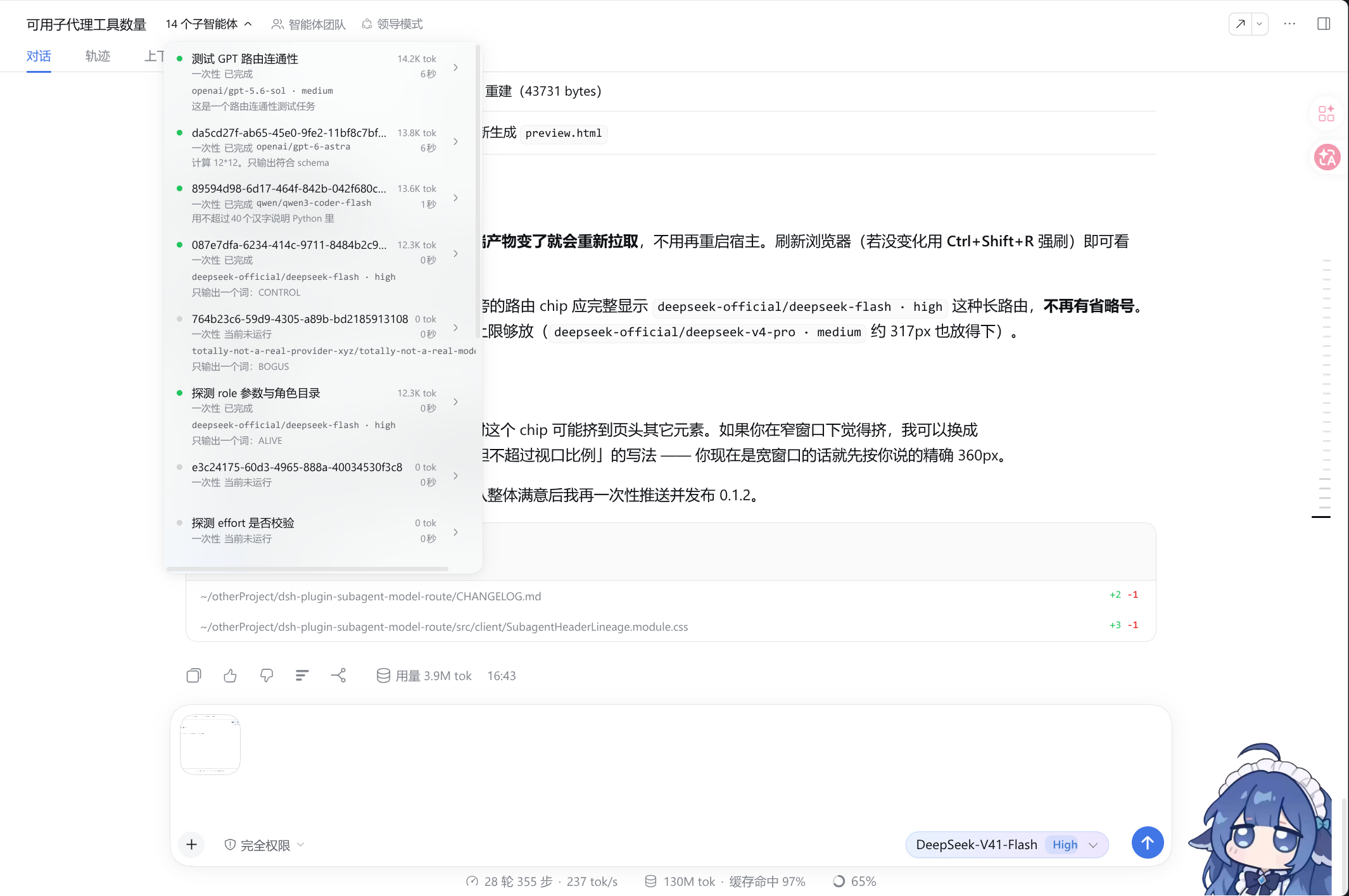
The parent's catalog: thirteen subagents, each row stacking the name, a mode · activity · route badge line, and the durable title below it. The routes shown (gpt-5.6-sol,gpt-6-astra, qwen3-coder-flash, deepseek-flash) are the ones those delegations actually
ran on.
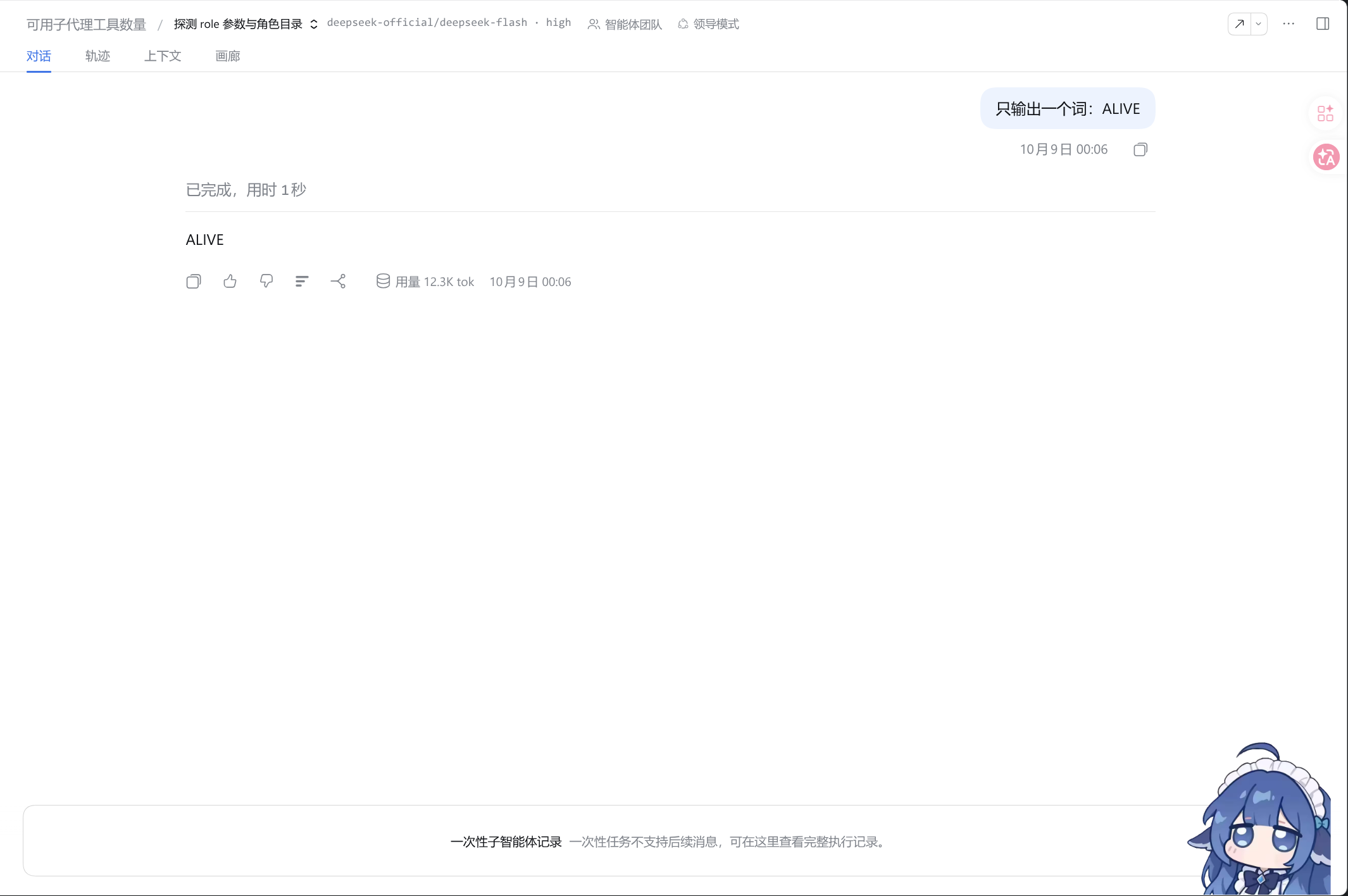
Opening a child session: the route (deepseek-flash) sits beside the lineage breadcrumb, in
the header, above the read-only one-shot composer notice.
Effect
Two surfaces change, and nothing else:
| surface | before | after |
|---|---|---|
| Parent catalog row | name, then title · one-shot · running on one line |
three lines: name / one-shot running gpt-5.6-sol / title |
| Child session header | breadcrumb switcher only | breadcrumb switcher + the route |
A row whose child never issued a request shows no badge. Hovering a badge gives the fullprovider/model · reasoningEffort, and the row's accessible name carries the route too.
Effect, expressed as consequences
Worth reading before installing. This plugin deliberately shadows shipped UI, and that has
a price:
- Rows get taller. 44px → 59px, so the dropdown, capped at
min(560px, 100vh - 140px), now shows roughly 9 rows instead of 12 before it scrolls. - You fork that region of the shipped UI. The catalog contract marks this seat
replaceRisk: 'shadows-shipped-ui'. Upstream improvements to those two occupants —
including DeepSeek adding a model column themselves — will not reach you; you have to
re-vendor and re-apply the two modifications (see PATCH-RECORD.md). - A shipped-UI bug in that region becomes yours. The renderer is a verbatim copy of the
shipped one (the copy even reproduces upstream's React duplicate-key warning about the child
session id). - The stylesheet is injected twice. The vendored CSS module is a second copy of the
shipped sheet, so the page carries both. It is small, and the hashed class names differ
(different file content), so nothing collides. - The shipped occupants are shadowed, not unregistered. They stay registered and render
nothing — a small, inert cost. - It duplicates the
subagent-directordock if you run both. That plugin draws the route
under the composer for an opened child; this one draws it in the header. Expect the route
twice in the same view until you drop one of them. - The route is the last request's route. A child that switched models mid-life shows only
the most recent one, and "no badge" means "never issued a request", not "unknown". - Only those two surfaces change. The read-only composer, the Sidebar chat tab, and the
@
reference source stay shipped. - Uninstalling reverts everything. Nothing is persisted and no host-side surface changes;
remove the package from the profile'sbundlesand restart. - Activation needs a host restart.
dsh.clientis composition-level config and does not
hot-reload.
Why this is a plugin that shadows the shipped UI
The shipped @deepseek-ai/dsh-client-ui-subagent decides what those two surfaces render, and
it cannot be extended additively: conversation.session.header.lineage is a single cell with
no registerOptions and no declared children, and there is no per-row slot at all. Taking the
seats over is the only way to add the route from outside.
The slot registry throws when a second registration lands on an occupied cell at the same
priority and shadows on any different one, so this plugin registers both seats atpriority: -1 (the shipped occupants own the default 0):
| seat | shipped occupant | how this plugin takes it |
|---|---|---|
conversation.session.header.lineage (single) |
SubagentHeaderLineage |
shadow at priority -1 |
conversation.session.header.actions (list) |
SubagentCatalogAction (id subagent-catalog) |
re-register the same id at priority -1 |
The route itself comes from the durable modelSelection projection (recorded on everyrequest/header), read through the same summary.projectionValues the row already uses for
token usage and timing — so this adds no RPC, no host change, no projection, no new slot.
Mounting
Mount it as a profile bundle, exactly like any other local plugin:
// ~/.dsh/profiles/web/package.json
"dependencies": {
  "dsh-plugin-subagent-model-route": "link:/path/to/dsh-plugin-subagent-model-route"
},
"dsh": { "profile": { "bundles": [
  // ...after @deepseek-ai/dsh-base and @deepseek-ai/dsh-web-app
  "dsh-plugin-subagent-model-route"
] } }
Or install it the supported way, which edits both lists for you:
dsh plugin --profile web add dsh-plugin-subagent-model-route     # from npm
dsh plugin --profile web add ./dsh-plugin-subagent-model-route   # from a checkout
Then restart the host.
Development
node_modules/ in this checkout is a dev-only shim of symlinks into a harness checkout (the
host's own react/react-dom/@deepseek-ai/*, plus the monorepo's tooling), because the@deepseek-ai/* packages are only published to npm as a 0.0.1-rc.1 placeholder. A normalnpm install against the versions listed in devDependencies replaces it.
npm run check      # typecheck -> build -> headless smoke (15 checks)
npm run build      # tsdown: lib/index.js (host half) + lib/client/index.js (closure factory)
npm run watch
npm run smoke      # renders both seized seats under jsdom
The out-of-tree build in tsdown.config.ts restates the two contracts the
monorepo's own clientBundle() preset enforces — thewindow.__ModuleLoader__.load({ id, factory }) handoff, and the lightningcss pass that turns*.module.css into a hashed class map plus a tagged <style> injection — because that preset
locates packages by globbing the monorepo and cannot build a package outside it. The build needs
only tsdown + lightningcss: the host-provided packages stay external and are never
resolved, which is what keeps a git install from failing on unpublished @deepseek-ai/*
versions.
scripts/smoke.mjs runs the real artifact through the real handoff and asserts, among other
things, that the bundle's require set is exactly the four platform seed rows (react,react/jsx-runtime, react-dom, @deepseek-ai/dsh-client-ui-primitives) — a request the host's
module table cannot answer would be a guaranteed runtime throw.
Publishing
See PUBLISHING.md for the full checklist, the DSH-specific traps, and the
catalog-submission steps. The short version: fill in the CHANGE-ME repository fields, publish to
npm with lib/ built at publish time, verify in a clean profile, tag the repo with thedsh-plugin topic, then submit to the community catalogs.
Maintenance
The vendored renderer is pinned to the shipped one at deepseek-ai/deepseek-harnessmaster @ 5badb15009. When upstream changes SubagentHeaderLineage.tsx or its stylesheet,
re-vendor and re-apply the two modifications from PATCH-RECORD.md — or, on a
machine that owns the harness checkout, prefer the equivalent upstream patch
(UPSTREAM-PATCH.patch), which needs no shadowing at all.
License
MIT — see LICENSE. The vendored renderer originates from the MIT-licensed@deepseek-ai/dsh-client-ui-subagent.
安装
装一次目录插件,之后本站所有插件都能让 DeepSeek Harness 自动找、自动装:
dsh plugin add dshbase-catalog然后对 agent 说「帮我装 dsh-plugin-subagent-model-route」,它会在目录里找到并自动安装。文档:dshbase-catalog · 已验证场景包。
Web profile:
dsh plugin --profile web add dsh-plugin-subagent-model-routeHeadless(CLI)profile:
dsh plugin --profile headless add dsh-plugin-subagent-model-route包信息
npm:dsh-plugin-subagent-model-route · 版本 0.1.0 · 实测环境 dsh 0.1.0-rc.6
实测报告
端到端验证通过:dsh 0.1.0-rc.6 上 L1 安装 + L2 加载 + L3 运行问答。
分享徽章
把这枚徽章粘进 README——它会链回本页,实测状态变化时自动更新:

[](https://dshbase.com/zh/plugins/dsh-plugin-subagent-model-route/)<a href="https://dshbase.com/zh/plugins/dsh-plugin-subagent-model-route/"><img src="https://dshbase.com/badges/dsh-plugin-subagent-model-route.svg" alt="dshbase 实测可装"></a>